
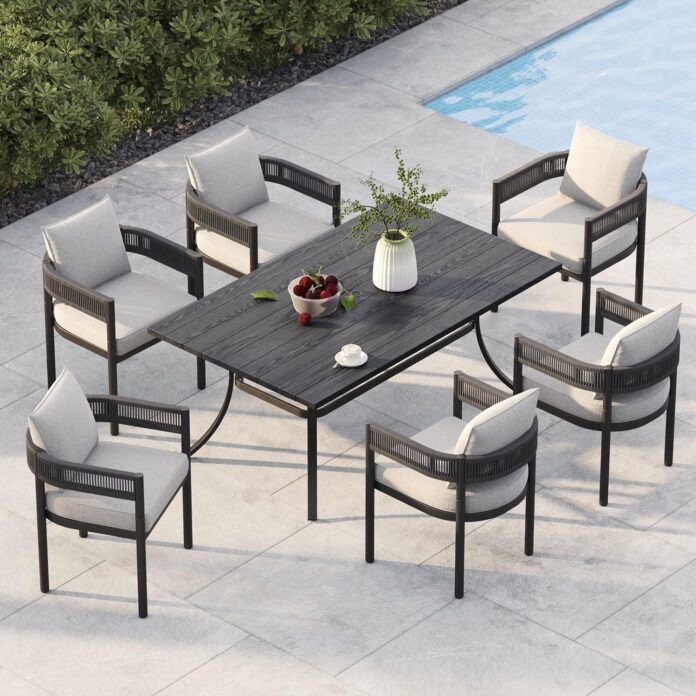
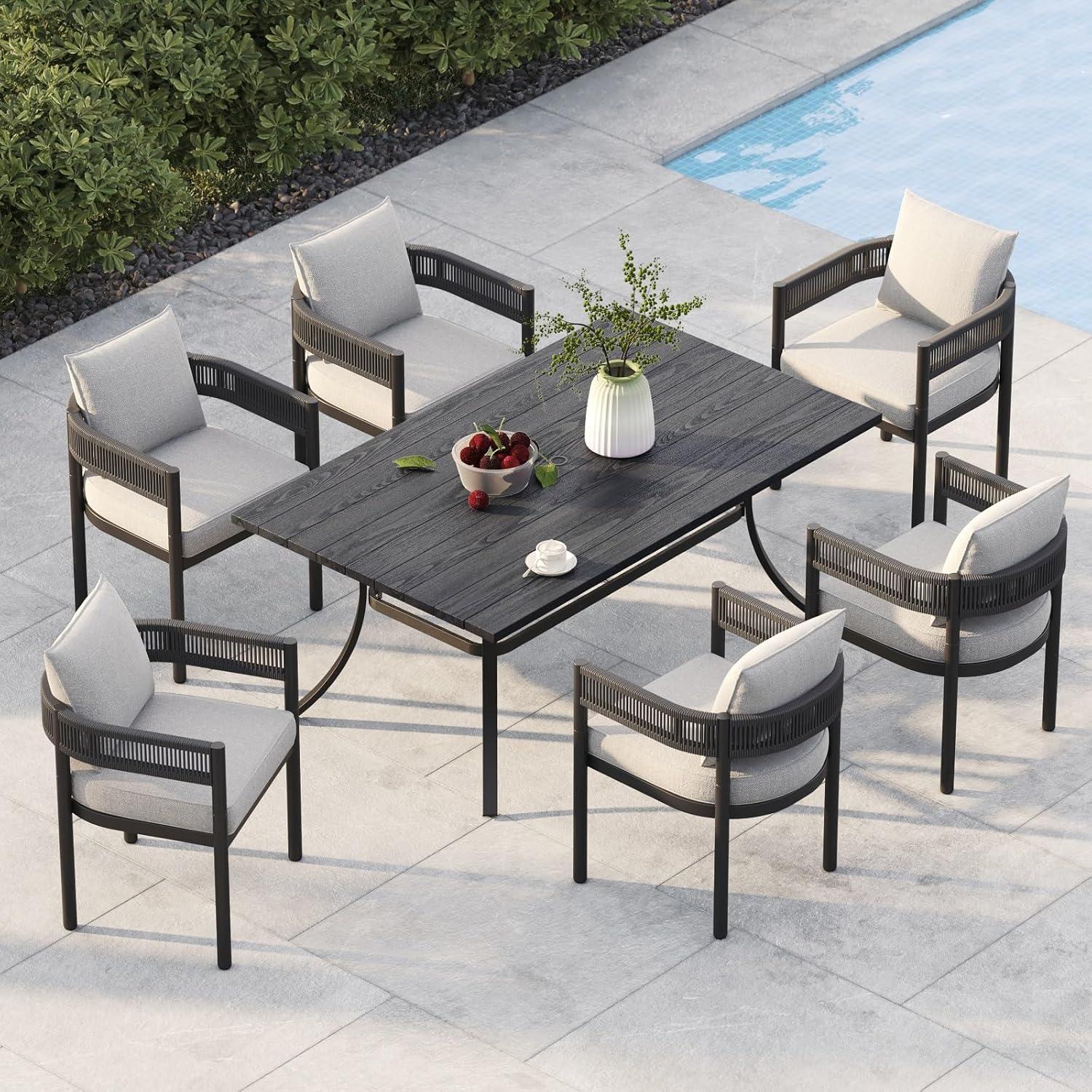
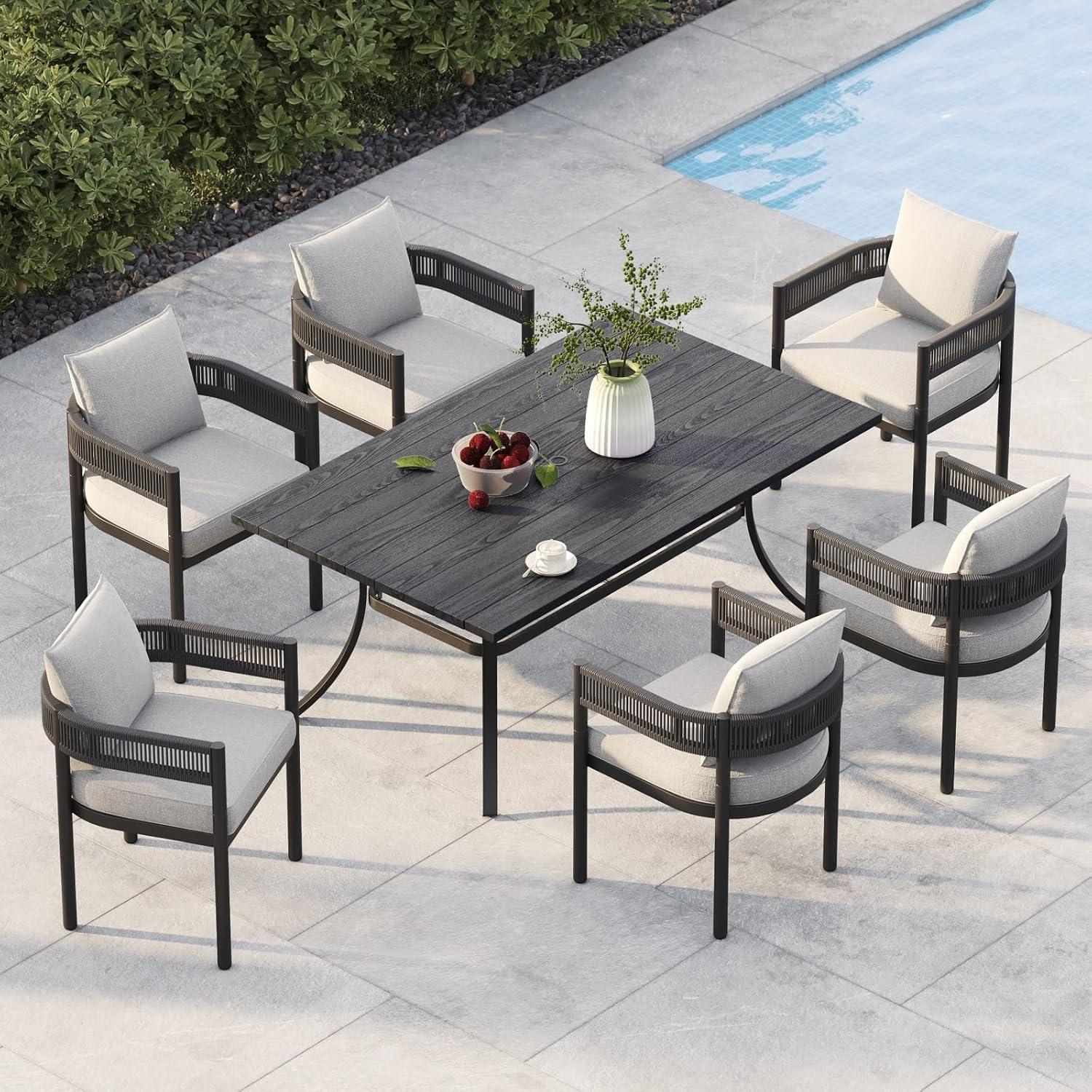
Grand patio’s 7-piece Outdoor Dining Set — a black metal and woven-wicker ensemble with a woodgrain tabletop — settled into the sun on my back patio with a calm, everyday confidence. You notice the coolness of the metal frame under your palm and the wicker’s faint give as you brush it, while the light-beige cushions press down with a modest, three‑inch softness. The rectangular table has a hand‑brushed woodgrain that catches crumbs and late afternoon glare differently than the matte frame, and the umbrella hole sits neatly off-center like a purposeful afterthought. Up close the pieces feel solid and a little heavy, their dark silhouette giving the group visual weight without shouting. It reads like furniture that was used yesterday and will be used again today — practical in its details, unobtrusive in its presence.
Your first look at the Grand patio seven piece arrangement on your patio
When you first bring the set onto your patio, the scene reads in layers: the rectangular table settles into the middle of the space while the chairs form a loose ring around it, their rounded backs softening the straight edges of nearby railings or paving. From your vantage point a few steps back you notice how the dark woven frames and the lighter cushions play against the existing hardscape — the wicker’s texture catches the late-afternoon light and throws a faint pattern across the floor. The tabletop’s surface glows differently depending on the angle; when you lean in you can make out the grain and the small central opening that breaks the plane of the table.
You find yourself doing small,habitual things: nudging a chair a few inches to line up with the table,adjusting a cushion so the seam sits flush against the back,smoothing a corner that has creased during unpacking. As you slide a chair under the table it tucks in neatly in moast spots but tends to need a slight lift on uneven paving. The arrangement instantly creates a focal point without completely closing off the rest of the patio — sightlines remain open, and movement around the set feels defined but not cramped. Nearby shadows and breeze animate the woven surface, so the first impression subtly changes as you move around and as the day progresses.
How the black woven metal and the woodgrain table sit visually in your light and shade
You notice the black woven metal and the woodgrain tabletop changing roles as the light shifts. In bright sun the black weave absorbs more of the glare, so the weave’s texture reads as a dense, matte silhouette; small highlights catch on the raised strands and the pattern throws crisp, lace-like shadows across the cushions and the table surface. When you move a chair or smooth a cushion, those shadows break and reassume new shapes, the pattern seeming to ripple with small gestures.
In softer or dappled shade the metal’s weave relaxes visually — the individual strands resolve more clearly and the black can feel a touch warmer, less flat. The hand-brushed woodgrain on the tabletop responds differently: side light brings out the directional strokes and a subtle depth in the finish, while diffuse light tends to even out the tone so the tabletop reads as a calm, single plane.At dusk or under warm artificial light the table takes on a gentle amber cast and the weave becomes a low-contrast backdrop, the interplay between dark lattice and warm grain becoming less about sharp shadow and more about texture together.
| Light condition | Black woven metal | Woodgrain tabletop |
|---|---|---|
| Bright sun | Crisp contrast, small glossy highlights, defined shadow lace | Visible brush strokes, stronger grain contrast |
| Dappled/partial shade | Texture reads more detailed, shadows soften | Directional grain visible but toned down |
| Evening/indoor warm light | Lower contrast, becomes a subdued backdrop | Warmer tone, grain appears fuller and smoother |
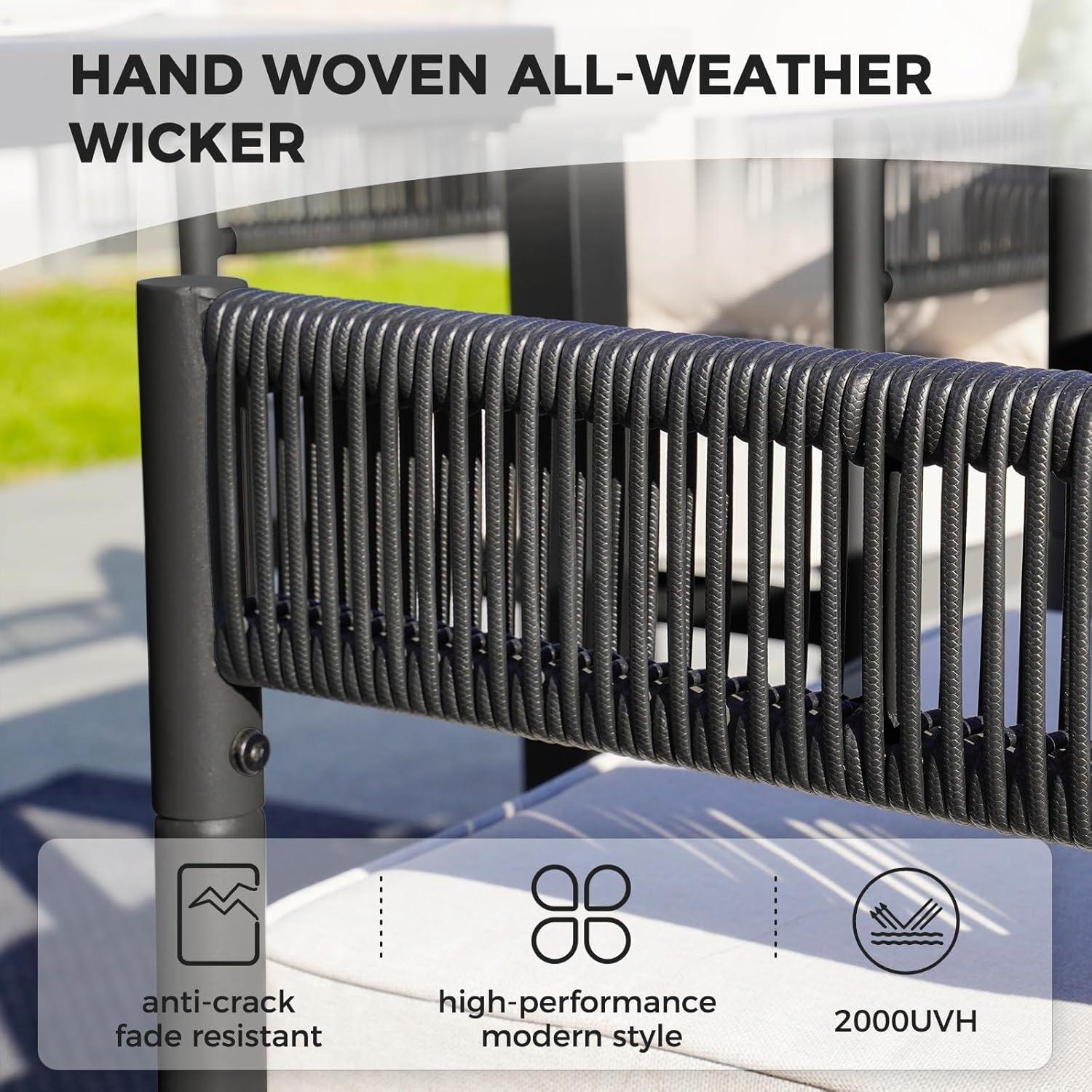
Up close with the frame weave and cushion materials you can touch and see
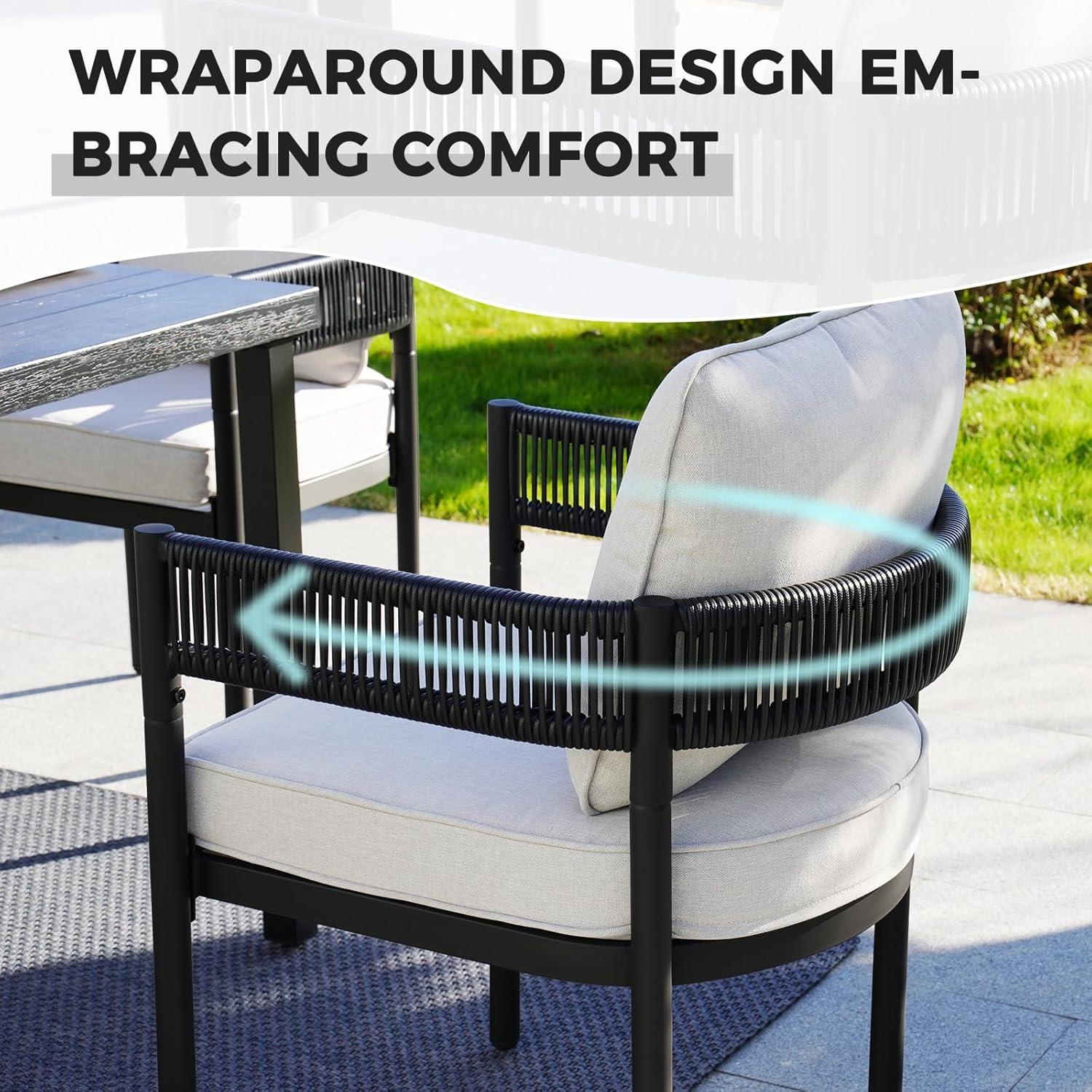
Get close and you can follow each strand of the synthetic wicker as it winds around the frame. Running your hand along an armrest, you feel the subtle ridges where strands cross and the occasional coolness of the metal beneath the weave. The pattern is tight enough that fingers don’t slip through, yet there’s a small, regular gap at each intersection where dust and tiny crumbs can catch. In motion—when you slide a chair back or lean against the side—the weave gives a little, a near-silent flex that settles once you stop moving; you might find yourself brushing at a stray fiber or smoothing the corner where the weave meets the frame.
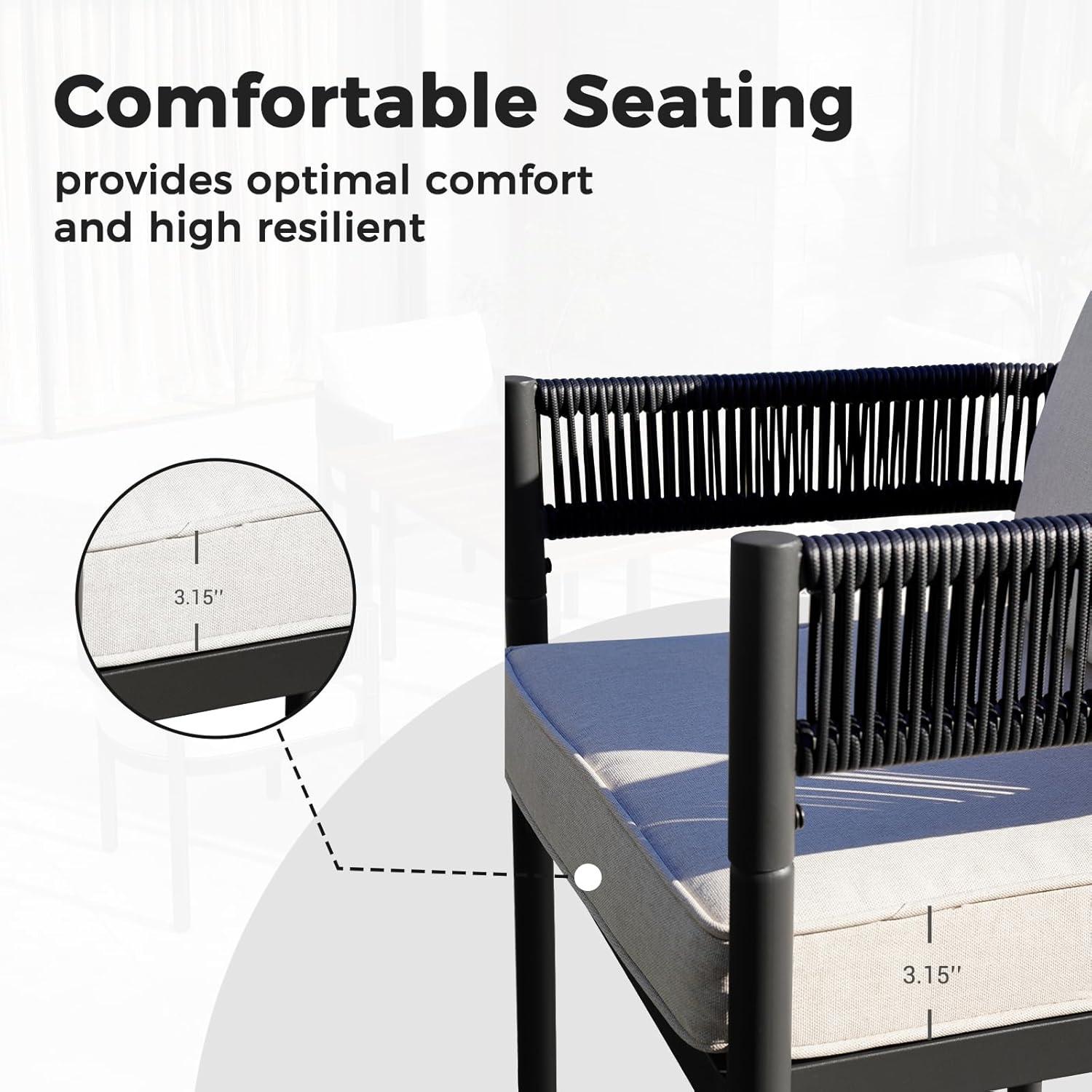
Up close to the cushions, the cover feels soft against bare skin and the stitching lines are plainly visible along the edges. When you press a palm into the seat pad it compresses and then eases back out; after sitting you often reach down to nudge a cushion so it sits flush against the back, or to smooth a wrinkle where the seam puckered. Small habits—tucking a loose corner, angling the cushion slightly—are common the first few uses. Below is a speedy tactile snapshot to help you picture those details.
| Feature | What you notice when you touch |
|---|---|
| Wicker weave | Fine, ridged crossings with slight give; tiny gaps where debris can lodge |
| Armrest area | Textured surface with a cool, solid feel from the frame beneath |
| Cushion cover | Soft, slightly textured fabric; seam lines visible and easy to smooth by hand |
| Cushion core | Compresses under pressure and slowly regains shape; tends to shift a bit until settled |
What happens when you take a seat the cushioning back angle and arm reach for you
When you lower yourself into the chair the seat cushion gives first — a noticeable initial sink that then settles into a firmer support as your weight shifts. You might smooth the cushion with a hand or shift your hips a little; the fabric and filling respond by compressing more where you press and springing back when you move. As you settle in, the seat depth lets your thighs rest without feeling like you’re perched on the very edge, and small adjustments (sliding forward to reach the table, scooting back to lean) change how much the cushion compresses beneath you.
The back angle becomes obvious almost immediately. Sitting upright, the backrest tilts you slightly back rather than locking you perfectly vertical, so your shoulder blades meet the weave and your lower back finds a gentle contact point. If you recline, weight transfers up the backrest and the lower seat gives a little more; that shift alters how your arms fall and how close your torso sits to the tabletop. The armrests catch your forearms at a modest height — firm to the touch — and when you reach forward for a plate or a glass your elbow movement is short and natural in most positions, though scooting forward shortens that distance even further. You’ll find yourself periodically straightening seams, flattening the cushion, or nudging the chair a touch to recalibrate that exact reach and angle while you stay seated.
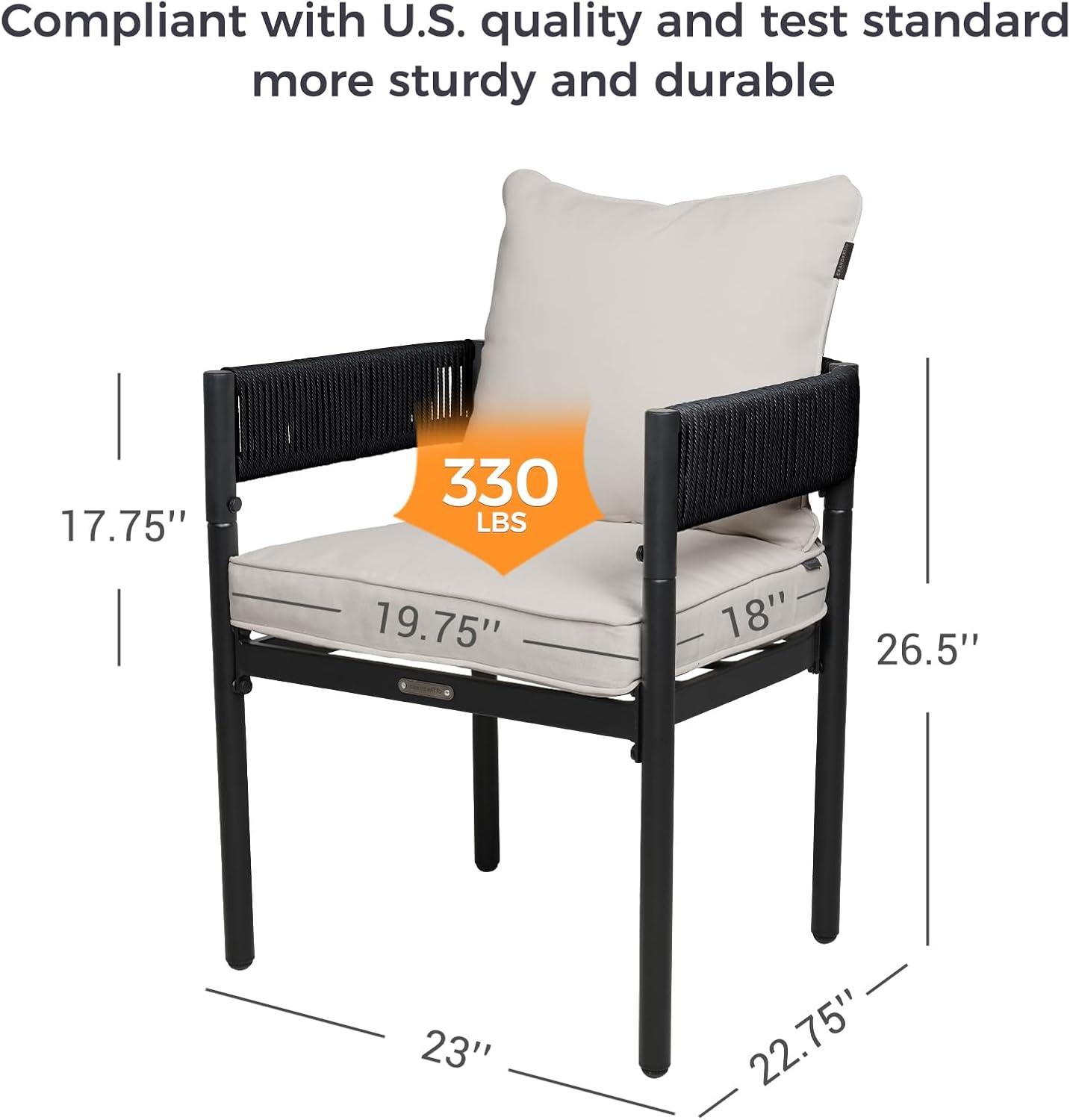
Measured proportions the table footprint chair spacing and how they occupy your terrace
Placed on a typical terrace, the set reads as a compact dining block rather than scattered pieces. With the chairs pushed in, the group forms a near-rectangular mass that usually sits flush to whatever edge it’s nearest to, leaving a clear lane along the opposite side for passage. When a chair is pulled back for seating, the visual footprint elongates—cushions compress slightly and the woven sides bend with the motion, so the occupied space feels a little larger than the pieces look while stowed.
Movement and use reveal subtle spatial behaviours: chairs prefer to rotate outwards rather than slide straight back, so the clearance needed for a comfortable exit path tends to be lateral as well as rearward. If an umbrella is centered through the table, the whole arrangement centers itself on the terrace, which can reduce usable peripheral space; when the umbrella is removed, the table still anchors traffic flow. On narrower terraces, the set commonly leaves a narrow walkway on one side and a more generous area on the other, rather than an even split.
| Use state | Observed occupied space (typical) | Notes on movement |
|---|---|---|
| Chairs tucked | Compact, near-rectangular | Forms a stable block; easier to sweep around |
| Seated / chairs pulled out | Footprint noticeably extends rearward and laterally | Cushions compress and wicker flexes during entry/exit |
| With umbrella mounted | Arrangement centers and defines circulation | Peripheral space often asymmetric |
These patterns are what tends to show up when the set is used regularly on a terrace: a defined central dining zone, chairs that nudge the usable perimeter when occupied, and small, shifting gaps as cushions are adjusted or chairs are nudged into place. For detailed dimensions and official layout specs, consult the product page.
View full specifications and size options
Suitability for your space and how reality compares to your expectations including practical limits you may encounter
In everyday use the set occupies a definite presence rather than blending into the background; on narrower patios or balconies there is often only a slim corridor when chairs are pulled out, while on wider decks the arrangement feels more open. The chairs’ rounded arms and metal frame mean they don’t tuck fully beneath the tabletop, so the common sight is chairs sitting partially exposed even after being pushed in. With conversation and movement around the table, the wicker shows a little give at the edges of the seats and the cushions compress visibly before springing back, which leads to the frequent, almost automatic gesture of nudging cushions and smoothing seams after people sit down.
Daily handling reveals a few practical limits: moving a single chair across rough paving typically requires a steady grip and both hands, and the set’s footprint leaves limited room for extra serving carts or a large centerpiece when the umbrella is in place. The umbrella pole seats into the tabletop hole without fuss, though poles without a stabilizer can rock slightly in breezy conditions. fabric soiling and light creasing on cushions become noticeable sooner than the frame’s surface wear,prompting occasional spot-cleaning and re-fluffing.In most cases the set performs as expected for regular dining use, and routine small adjustments—straightening cushions, nudging chairs—become part of the normal pattern of use.
View full specifications and size options
What you unbox and the steps to get the set in place at your home
When you open the shipping cartons, expect several neatly packed bundles rather than one single crate. Cardboard flaps and strips of foam come away first; underneath are the metal frames wrapped in plastic, the stacked chair shells with their woven wicker exposed at the edges, the tabletop faces laid flat, and a couple of smaller boxes holding hardware and the included tool. Cushions arrive compressed in vacuum-sealed bags and need a short period to regain fullness; they feel firm at first and tend to loosen up as you handle them.Small plastic bags of bolts, washers, and allen keys are usually grouped by step and taped to a larger sheet of instructions.
| Item | How it typically appears |
|---|---|
| Table components | Tabletop and leg sections wrapped separately; tabletop often has protective film along the woodgrain face |
| chairs | Chair frames nested or stacked; wicker visible, sometimes with foam padding between pieces |
| Cushions | Compressed in sealed bags, straps or ties tucked inside |
| Hardware pack | Small bags labeled for each step, with an allen key or two included |
| Instructions | Folded sheet with exploded views; stickered parts list is handy for inventory |
To get the set in place, clear a flat area large enough to lay out parts; you’ll likely drag boxes close to where the table will sit to avoid multiple carries.Open the hardware pack and sort the bags roughly by label, then unbox and let cushions breathe while you start joining major pieces. Metal edges can feel sharp when you move frames—handle the table and chair legs with gloves or care and keep fingers clear of seam gaps as you align holes. Fastening typically goes from larger pieces to smaller: attach legs to the tabletop, bolt any cross-bracing, then assemble the chairs’ leg sections and seat bases. As you tighten fasteners,the wicker can shift a little; pause occasionally to nudge the weave back into line so gaps don’t catch the allen key or cloth.
Once the larger assemblies are upright, set the table where you want it and place chairs around it to check spacing. The cushions will need a few tugs and smoothing strokes to sit flush in their covers; you may find yourself smoothing seams and nudging the cushion ties through slots until they sit evenly. If your patio surface is slightly uneven, you’ll notice the table feet or chair legs wobble until you rotate their adjustable glides or add a small shim. Finish by wiping any packing dust from the tabletop and brushing off loose fibers from the cushions before you start using the set.
How the Set Settles Into the Room
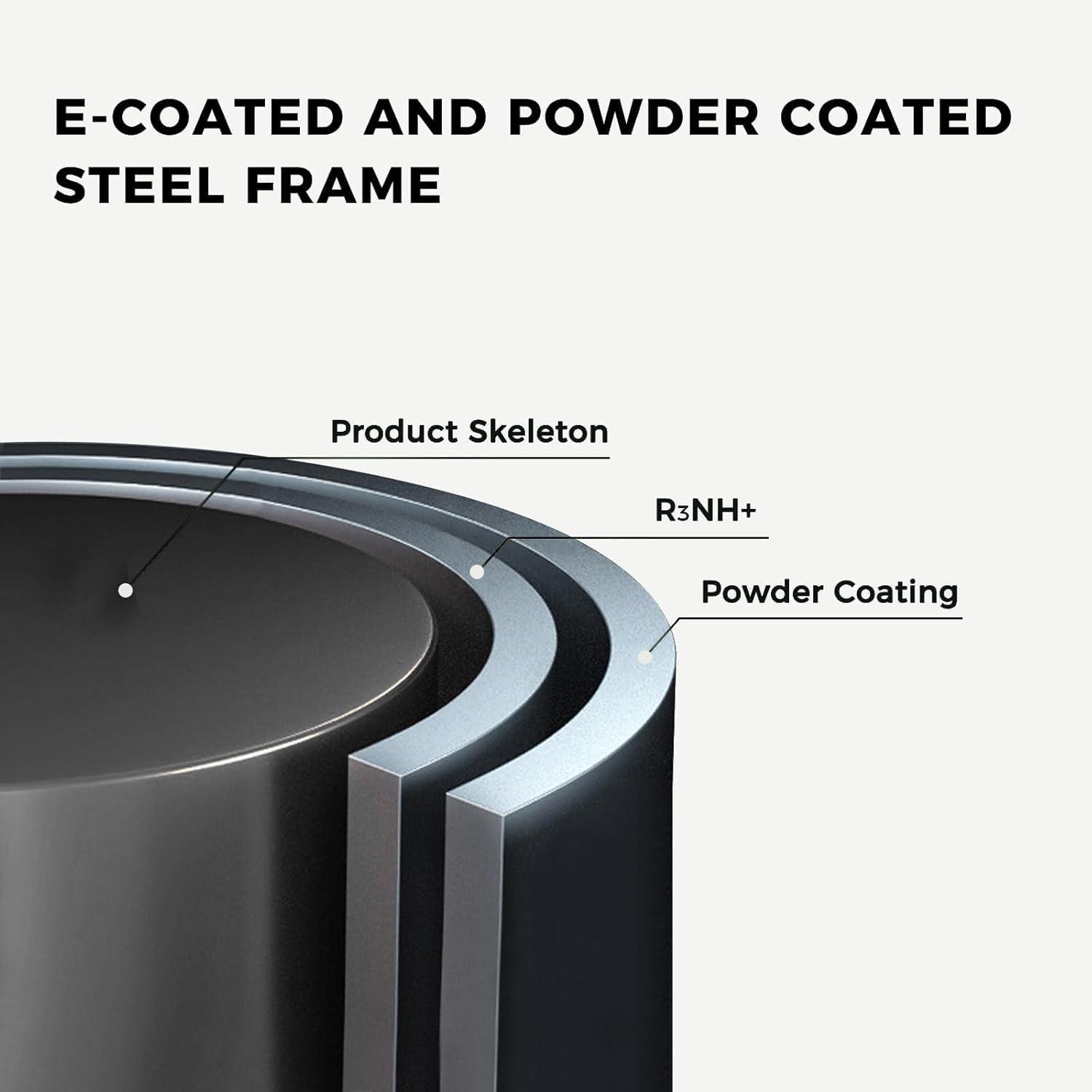
Living with the Grand patio Outdoor Dining Set, 7-Piece Patio Table and Chairs Set, Metal Woven Wicker Fixed Patio Chairs with Thickened Cushions & 1 Rectangular Woodgrain Dining table with Umbrella Hole (Black) over time, you notice how it quiets into the rhythm of the patio rather than announcing itself. Chairs tuck into familiar spots, cushions soften where people sit most, and the table collects the small, daily things that mark regular household rhythms. The woven surfaces and tabletop pick up faint scuffs and a softened sheen as the room is used, subtle traces of everyday presence. After a while you barely remark on it and it stays.
As an Amazon Associate I earn from qualifying purchases.
