
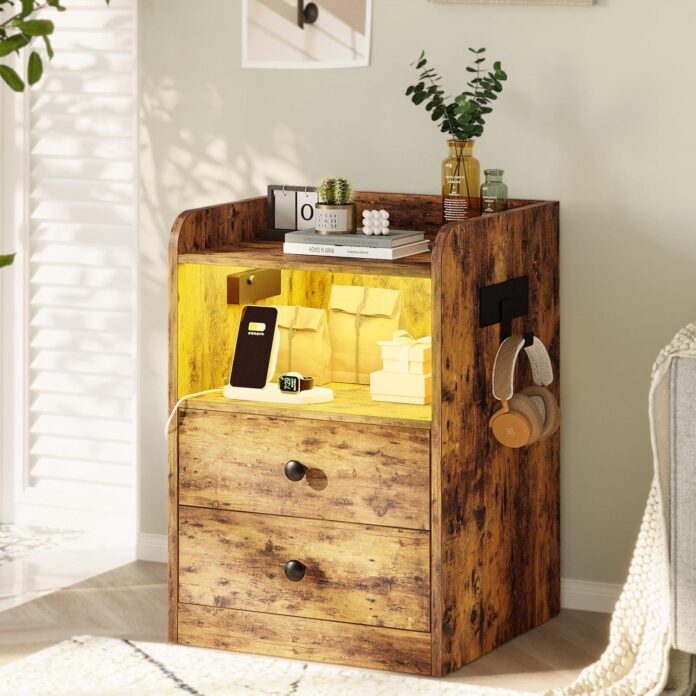
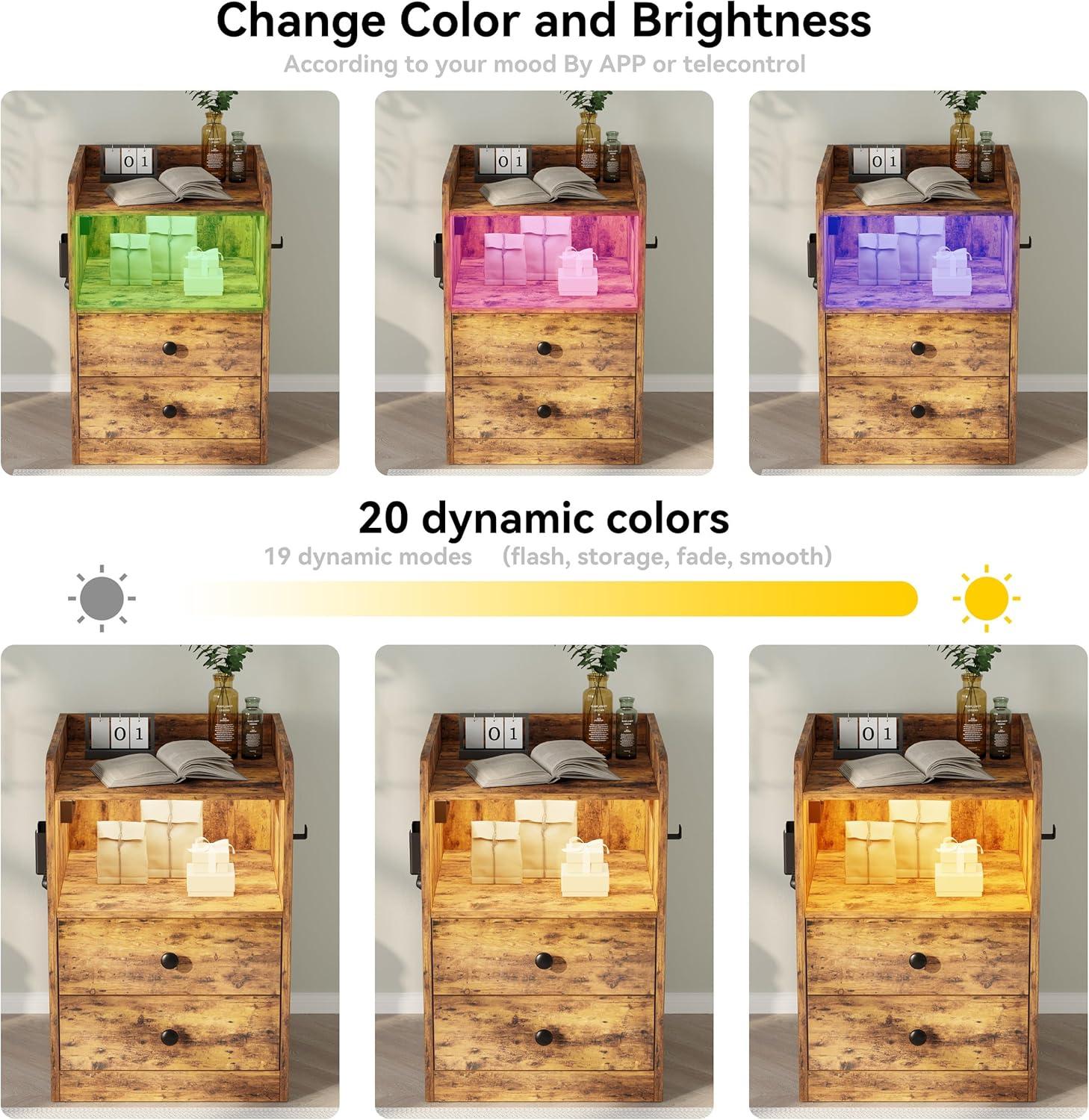
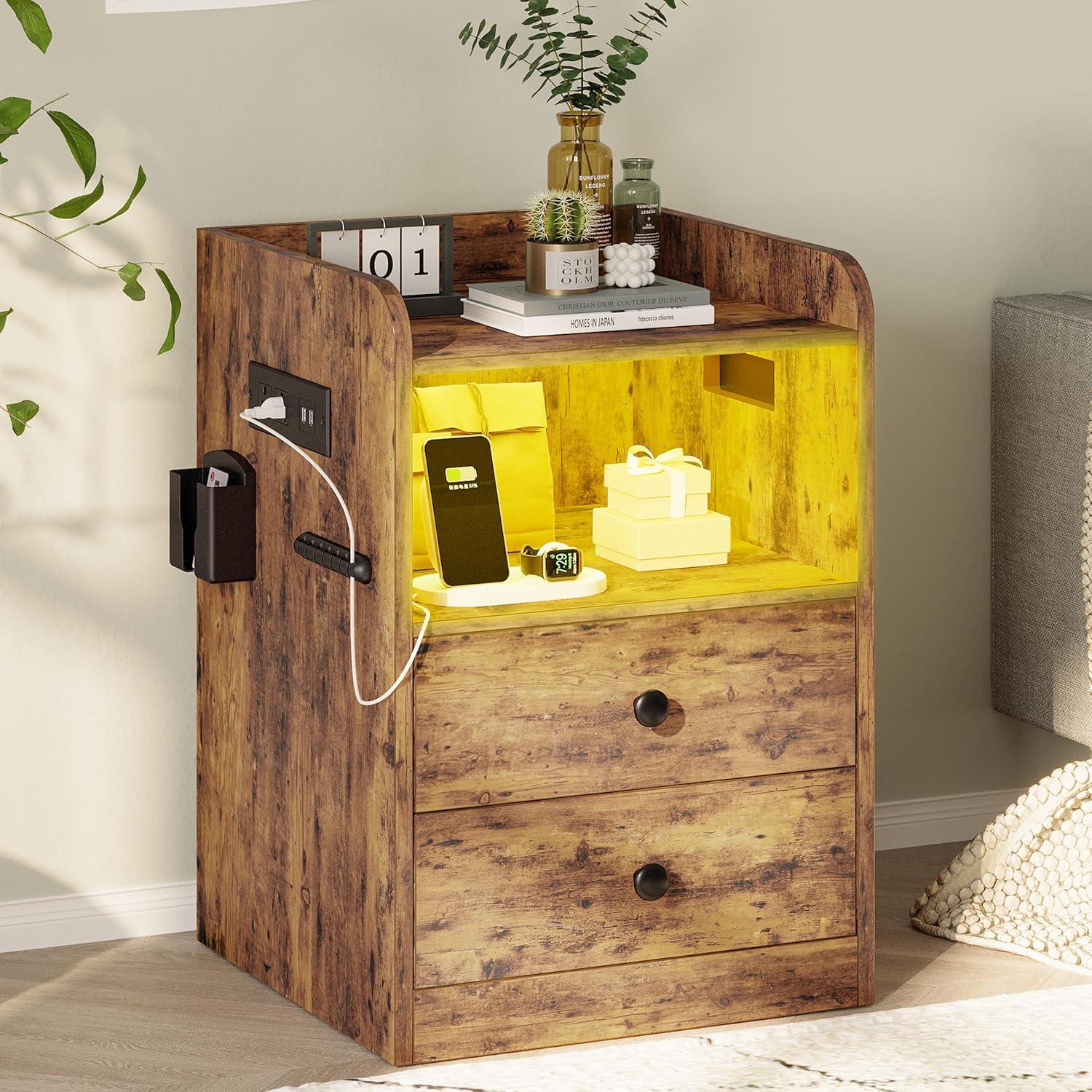
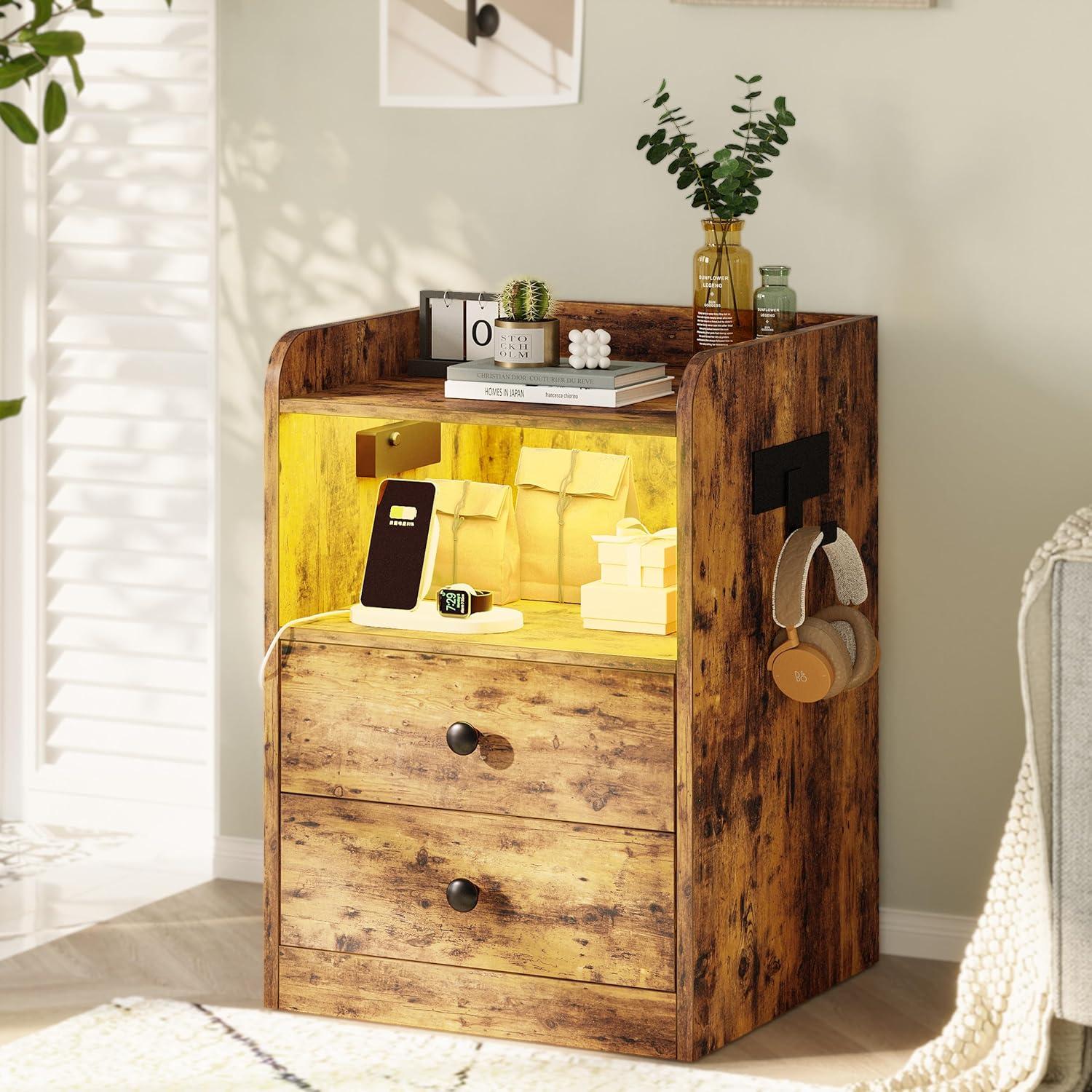
At dusk the strip of LED under the top lip is the first thing you notice, casting a low, changeable glow that softens the vintage brown finish without demanding the overhead light. About two feet tall and roughly a foot-and-a-half square, the LIKIMIO Nightstand with LED, Charging Station & USB Ports — you can just call it the LIKIMIO nightstand — reads as quietly solid: the faux-wood grain has a faint texture under your palm and the edges carry a practical little lip that keeps things from sliding off. Open shelf and two drawers tuck into its visual weight, while a side charging ledge and the cord channel make themselves known more by the tidier tabletop than by fanfare.
What you notice first when you unbox the LIKIMIO nightstand with LED and USB ports
When you lift the flaps, the first thing that hits you is the careful packing: foam corners and plastic wrapping keep each panel from rubbing against the next, and a thin protective film peels away from the surfaces with a soft snap. the vintage-brown finish is visible immediately — not glossy, more muted — and you can see the drawer fronts and top without having to unstack anything. There’s a faint factory smell that fades after a few minutes, and the heavier panels sit beneath lighter pieces so the box feels denser on the bottom when you tip it open.
Under the top layer you’ll find the loose parts and paperwork arranged where you’d expect them: a small instruction booklet, a sealed bag of hardware, a compact remote tucked into foam, and the drawer and shelf pieces laid out with protective corners. Each major board is labeled on the edge, so your eye follows the numbers before your hands do. As you move pieces aside you notice how edges and pre-drilled holes line up; the drawers sit in their slots but aren’t fixed, and the hardware bag contains both metal fasteners and a few plastic spacers that tend to clink together when you shift the box.
| What you see first | How it appears |
|---|---|
| Surface boards | Wrapped, labeled on the edges, muted brown finish visible |
| Drawers and shelf pieces | Stacked near the top, drawers slide freely but are unattached |
| Hardware & paperwork | Bagged and grouped, manual on top, small remote in foam |
How the vintage brown finish and compact silhouette sit in your bedroom
You’ll notice the vintage brown finish shifting with the bedroom light: warmer, almost amber near a bedside lamp; more muted in daylight. The surface shows subtle grain variation as you move around it, and casual touches—running a hand along the top, brushing crumbs aside, smoothing the duvet edge—make the piece settle into the room rather than dominate it. Because the silhouette is compact, the nightstand tends to read as a low, unobtrusive presence beside the bed; reaching for your phone or a book feels immediate and habitual, with small adjustments (angling a lamp, nudging a coaster) integrating the table into nightly routines.
Observed from a neutral angle, the brown tone tends to blend with darker floors and to contrast more against lighter walls, producing different visual emphasis depending on the surrounding surfaces. the narrow footprint can feel space-efficient in tighter layouts, though that compactness can also prompt slight reorganization of bedside items in most bedrooms; objects sit closer to the bed and hands tend to shift them aside more frequently enough than with a wider table. Light wear and faint marks become more visible over time in well-used spots, a behaviour that appears consistent across everyday use.
The materials you’ll handle and the way the two drawers and open shelf are assembled

When you unpack the pieces, the panels you lift feel like engineered wood — not solid lumber — with a printed, slightly textured brown grain on the visible surfaces. Edges reveal a layered core that can look a bit lighter than the face. Drawer faces are thicker than the side panels and have the same finish; the open shelf pieces are thinner and sit flush against the side rails once you fit them in place. The hardware bag contains an assortment of short screws, metal rails or plastic glide pieces, cam-type fasteners and a few wooden dowels or plastic pegs; the pulls fasten thru predrilled holes with short machine screws.
Assembly for the drawers and shelf is mostly mechanical: you assemble each drawer box from its front, back and side panels, lock those joints with the cam screws or small wood screws, then slide the completed box onto the runners or glide strips. The open shelf typically rests on pegs or slots cut into the side panels and is secured by tightening adjacent fasteners so it sits square. As you work, it becomes clear that alignment matters — lining up the predrilled holes and the numbered stickers while holding pieces together prevents the drawer faces from sitting slightly skewed and helps the drawers meet the frame evenly when closed.
| Component | What you’ll touch | How it fits together |
|---|---|---|
| Drawer front | thicker engineered panel with printed grain | Fastened to drawer box with cam screws or short machine screws |
| Drawer box | Thinner composite panels, edges show layered core | Joined by cam locks or screws; rides on metal/plastic glides |
| Open shelf | Flat shelf panel, lighter to lift | Seated on dowels/slots or fixed by adjacent screws |
| Back panel and small trims | Paper-thin board or thin composite | Stapled or screwed into grooves to square the frame |
Where your bedside essentials live and how the built in charging station and USB ports are arranged
When you set things down at night,they settle into three obvious zones: the tabletop,the open shelf and the two drawers. The tabletop is where the items you reach for most—phone, glass, bedside book—sit within the shallow lip that keeps small things from sliding off. The open shelf beneath the top is a convenient place for a stack of paperbacks or a tablet you want visible, while the drawers take the smaller, loose items you prefer out of sight; you’ll find yourself sliding a remote or pair of glasses into a drawer without thinking about it.
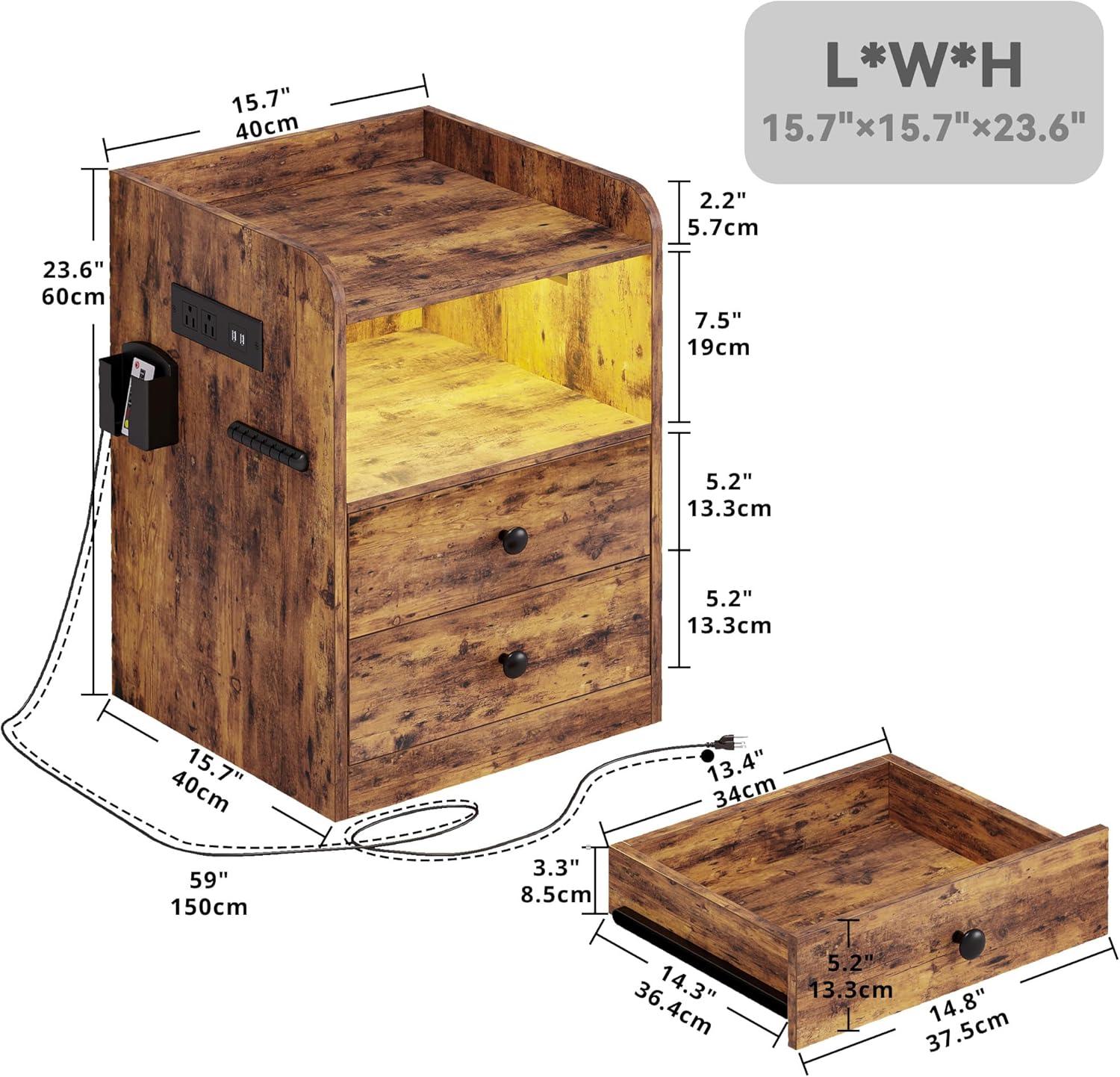
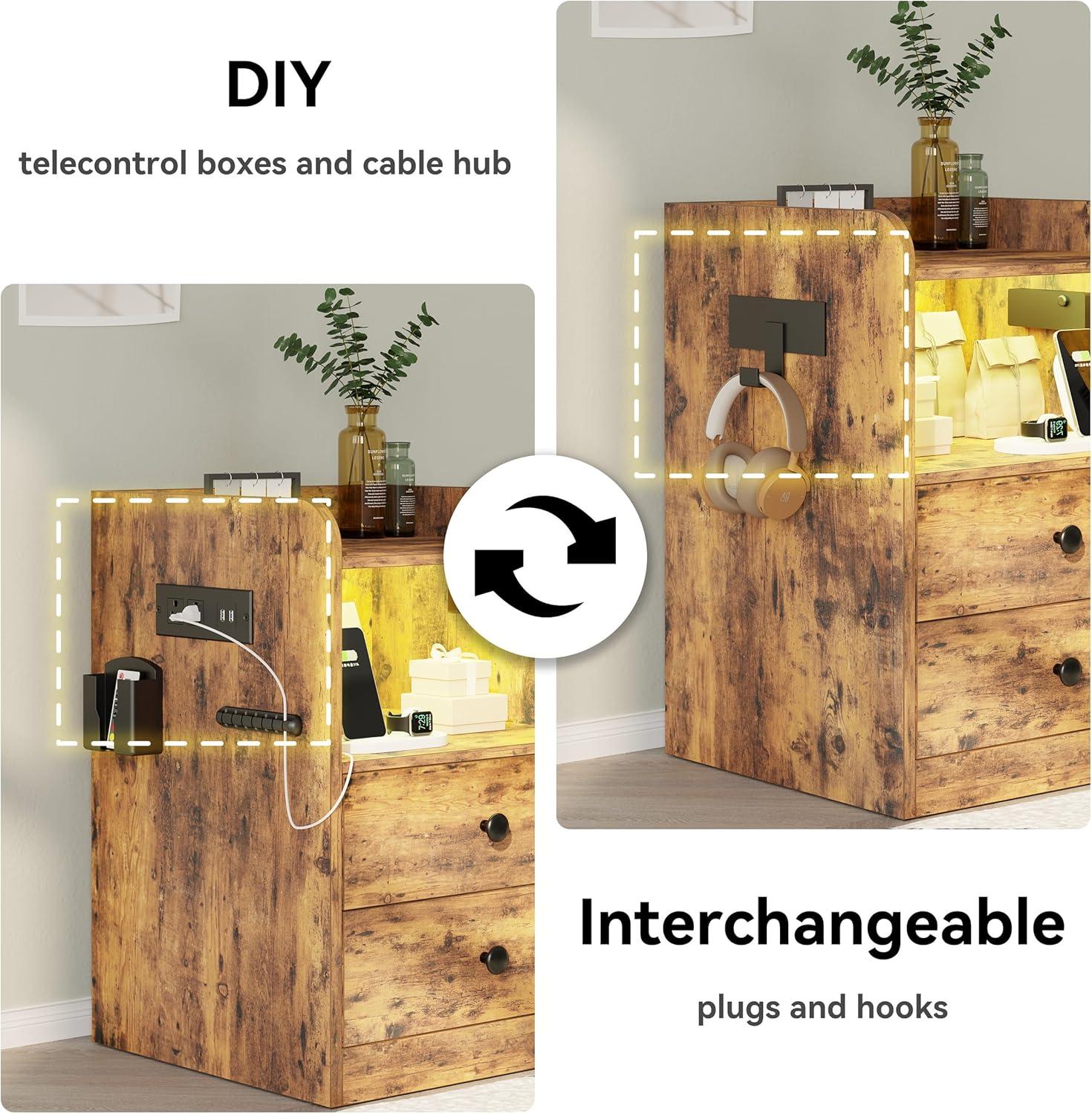
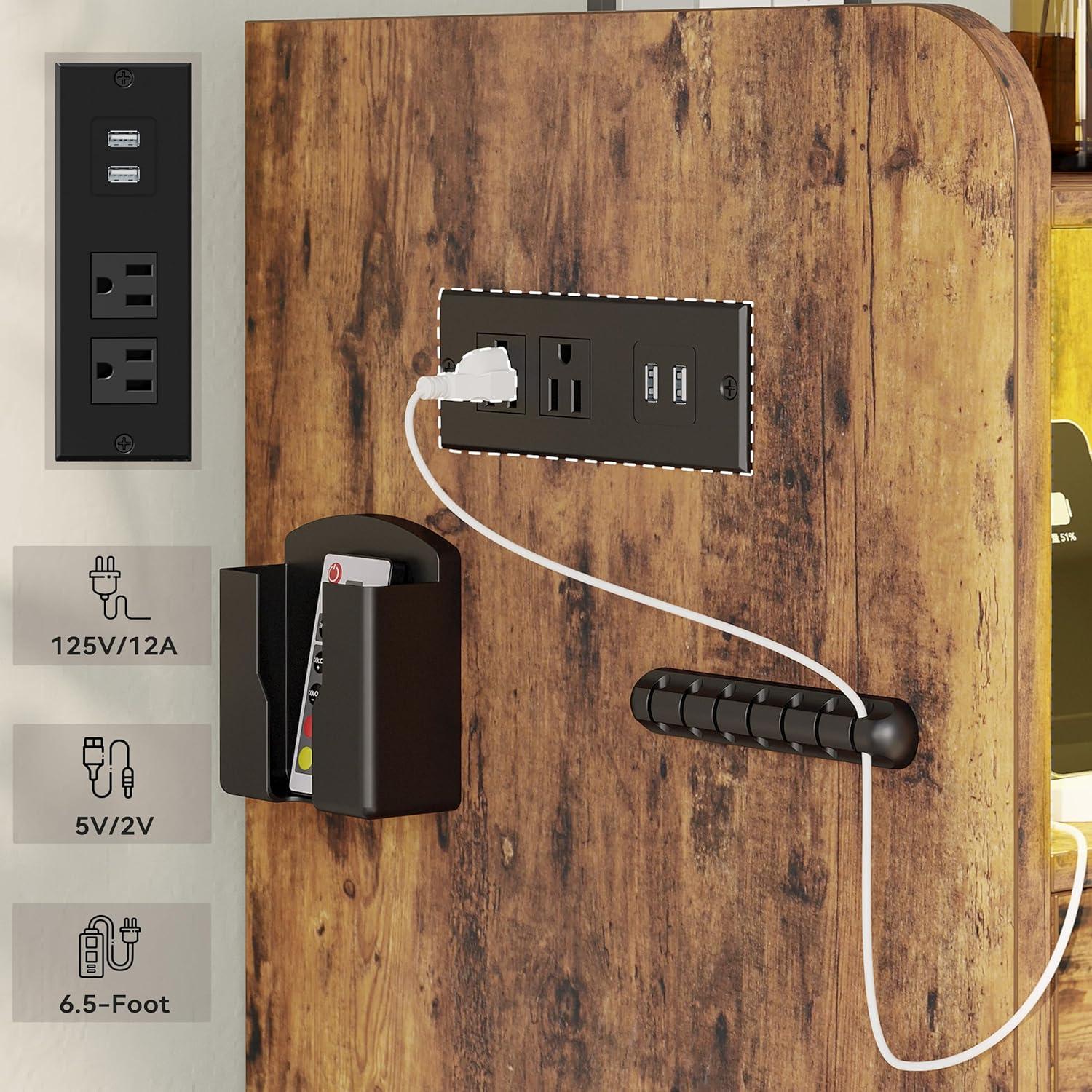
The charging hardware lives along the side edge rather than on the surface. The side-mounted block contains two AC outlets and two USB ports, with a built-in channel that guides cables down and back so they don’t sprawl across the top. In everyday use you tend to lay a device on the tabletop and drop its cord into that channel; cords then disappear toward the back or into the shelf below.The charging module can be moved to a different hook position if you adjust the nightstand’s setup, which changes how cords run and how much clear space you have on the top.
| Feature | Observed arrangement |
|---|---|
| AC outlets | 2, side-mounted block |
| USB ports | 2, alongside the AC outlets |
| Cable management | Integrated channel/organizer guiding cords to the back |
| Positioning | Mounted on the side; interchangeable with alternate hook positions |
Its dimensions and how it fits into common bedside layouts and furniture groupings
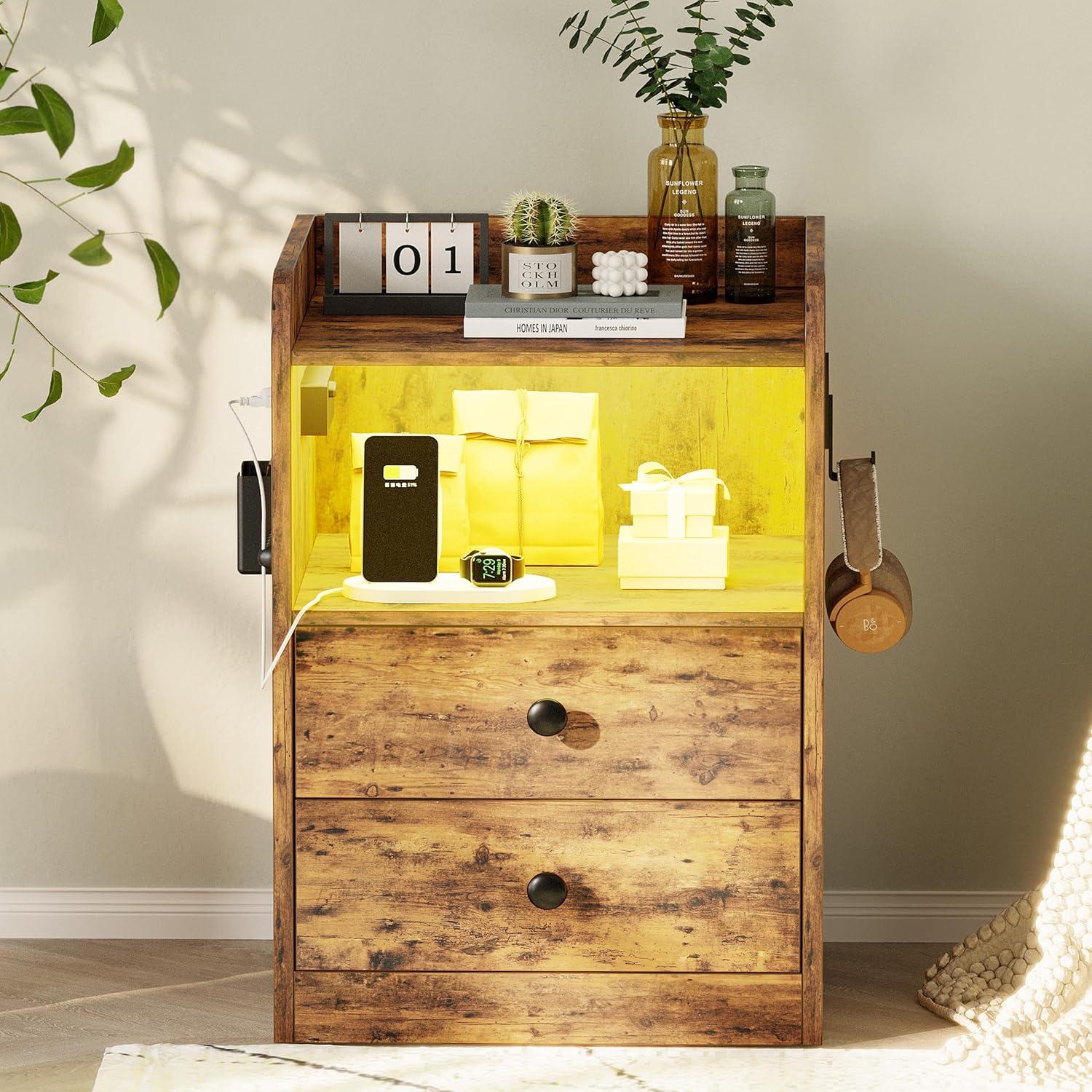
With a roughly 15.7-inch square footprint and a height of about 23.6 inches, you can slide this table into tighter bedside gaps or set it where a larger nightstand would feel crowded. The shallow depth means it rarely projects far into a narrow walkway, and the top surface usually sits within easy reach from a standard mattress without crowding the floor space beside the bed.
| Dimension | Measure | Common reference |
|---|---|---|
| Width / Depth | 15.7″ × 15.7″ | Small footprint; fits beside most single beds or within narrow passages |
| height | 23.6″ | Often near mattress-top level for mid-height bed frames (varies with mattress + frame) |
In many bedrooms,the nightstand’s top will sit roughly level with mattress heights in the low-to-mid twenties of inches; it tends to be slightly lower than very tall platform beds and a touch higher than very low-profile frames. placed next to a dresser or a chair,the narrow footprint leaves visible walkway and breathing room,and when two are set on either side of a bed they keep the layout compact rather than dominant. Small shifts—pulling slightly forward or nudging closer to the headboard—change how the nightstand relates to bedside lighting and seating, which is why it can feel different in cramped rooms versus more open arrangements.
How it measures up to your expectations and the limits you might notice in your daily use
In everyday use the nightstand tends to deliver the practical conveniences promised, though they show up in familiar, lived ways rather than as flawless features. The LED lighting provides a usable wash of light for late-night tasks; the range of colors and dimming steps is noticeable, but switching between very specific hues or fine brightness levels can feel a bit imprecise in the moment. The charging cluster on the side makes power easy to reach, yet bulky adapters and a tangle of cords often shift into view when devices are plugged in, and the cable organizer takes occasional nudging to keep things tidy.
Drawer and shelf behavior emerges gradually: the drawers slide and hold small bedside clutter without drama, but their movement is straightforward rather than silky, and a new-assembly stiffness tends to loosen after a few re-tightenings. The tabletop is serviceable for a lamp, a phone and a book, though placing more than that quickly makes the surface feel cramped. The finish and corners show normal signs of use over time — small scuffs or subtly dulled spots appear where objects are moved repeatedly.
| Expectation | Typical daily experience |
|---|---|
| Adjustable LED mood and brightness | Provides soft,usable light; precise color/brightness matching can be fiddly |
| Integrated charging and outlets | Convenient placement; larger plugs compete for space and cords can become untidy |
| Top surface and storage space | Holds bedside essentials comfortably; multiple items make the top feel crowded |
Care,upkeep,and the small signs of wear that appear over time
When you live with the piece, small changes tend to show up where you interact with it most. The top surface will usually collect faint water rings or scuffs from mugs and night‑time fumbles; these marks frequently enough sit on the finish rather than cutting deeply, but they can dull the sheen in high‑use spots. Drawer faces and the open shelf are prone to tiny edge dings and rubbing where you slide things in and out, and the corners can pick up paint‑nibbling chips if you brush them while moving around the room. Over weeks the screws that hold brackets and the charge-area mount may loosen a little, so drawers can begin to feel stickier or a hair off‑square after repeated use.
| Observed sign | When it tends to appear | How it looks in everyday use |
|---|---|---|
| Surface dulling / water rings | Weeks to months | Faint cloudy spots around cups or lamps; finish looks less even under light |
| Small edge chips and scuffs | months | Tiny pale nicks at corners or along the lip where items are moved |
| Drawer alignment / loosened fittings | Weeks to months | Drawers that start to stick,wiggle,or need a nudge to close fully |
You’ll also notice everyday deposits in places you might not expect: dust collects around ports and the cable openings,and crumbs or lint can lodge in the shelf recess. Cleaning habits tend to determine how quickly these signs appear; wipe marks and surface residue frequently enough respond well to gentle cloths, while accumulated grit behind hardware is what makes motion feel less smooth over time. these are small, commonly seen changes that develop with normal use and movement rather than sudden failures.
A Note on Everyday Presence
You notice, over time, how the LIKIMIO Nightstand with LED, Charging Station & USB ports, Night Table with 2 Drawers and Open Shelf, Adjustable Light, Vintage Brown eases into regular household rhythms — a surface that catches the lamp, a low shelf that keeps a book or two, a drawer that quietly takes loose change. In daily routines its edges become part of the pattern of movement in the room, and small scuffs or faint rings read like traces of use rather than interruptions. As the room is used and comfort behavior settles, it moves from being noticed to being habit, present in the background of ordinary days. It stays.
As an Amazon Associate I earn from qualifying purchases.
